
Partnering with UNICEF to Strengthen Disability Inclusion at the Frontline of Service Delivery
News-iag | May 12, 2026
Since the beginning of our work with UNICEF Headquarters Disability Team in 2022 on the Disability Inclusion Training Package for Frontline Workers, one thing has become increasingly clear: When people share a commitment to inclusion, change does not just happen, it snowballs!
The package was developed from a simple but significant recognition: Across countries and sectors, Frontline Workers such as health workers, teachers, social workers, humanitarian responders, and many others, are often the first point of contact for children with disabilities and their families, yet most have had little opportunity to understand disability inclusion through a rights‑based lens meaning people with disabilities continue to face stigma, marginalisation and exclusion. UNICEF’s vision was to create a practical, adaptable, globally relevant resource to help close this gap. IAG was commissioned to co-develop the training package, test it, and support its rollout across the globe.
From the outset, this has been a partnership built on trust. UNICEF HQ brought the global mandate and convening power; IAG contributed technical expertise, lived‑experience leadership, and practical insights rooted in frontline realities. Together, we shaped a package of six short modules, a user guide, facilitator materials, and focus briefs, all designed to be usable across a wide range of humanitarian and development settings.
What matters most is how UNICEF chose to position the package: Not as a one‑off training, but as a flexible resource that country teams can adapt, contextualise, translate, and use to strengthen disability inclusion across their systems in ways that are meaningful to Frontline Workers.
“The role of frontline workers is key to scaling up inclusion of children with disabilities. For UNICEF, one of the most important lessons from this work has been that inclusion only moves when we work together. Across countries, we are seeing frontline workers, OPDs, and partners bring their perspectives to adapt, localize, and carry this work forward in ways that reflect their realities, this is where inclusion becomes real in practice.”
—Gopal Mitra, Global Lead on Disability and Development, UNICEF Global Programme Division
Scaling up, reaching out
To date, we have supported UNICEF and partners to deliver contextualisation support, facilitator orientations, and Training of Trainers events (ToTs) to 24 countries, across seven regions, with two additional countries preparing their sessions.
Every country brings its own priorities, constraints, and creativity; each rollout adds nuance to the global picture and strengthens the package for the next context; and, critically, the training is resonating. As one participant shared after a session in Iran:
“The overall workshop experience was excellent. It provided valuable insights into the importance of inclusivity and equipped me with practical tools [for disability inclusion].”
The scale is encouraging, but what truly matters is what that scale enables: Shared understanding, new conversations, strengthened partnerships, and system‑level ownership of disability inclusion actions across the globe.
The ToT model as a lever for systems change
One of the strongest signals emerging from the global rollout is how well the ToT approach functions as a systems‑change tool.
- Building local ownership: The ToT model gives people the confidence, skills, and agency to take the package forward themselves. Rather than relying on external facilitation, country teams adapt agendas, translate materials, incorporate national legislation and data, and determine how best to reach frontline workers across sectors. This ownership is a critical ingredient of sustainability, reflected in comments like this from Iraq:
“This is Iraq’s first initiative to actively promote disability-related work… this initiative has been met with overwhelmingly positive reception… signaling a shift towards greater inclusion and recognition of disability rights.”
- Sparking ripple effects across institutions: Viet Nam, Iran and Libya have already prepared new cohorts of facilitators who will, in turn, train Frontline Workers in their organisations. These secondary waves of activity confirm that the package is becoming embedded in local systems. In Viet Nam, 98 per cent of participants reported they now “see disability in a new light” following the ToT.
- Bringing whole systems into the room: ToTs often bring together government ministries, UN agencies, civil society organisations, and Organisations of Persons with Disabilities (OPDs). Shared learning spaces give people a common language, a shared understanding of rights based approaches, and a practical way to plan together for broader change.
Different contexts, different pathways
In the State of Palestine, a fully online ToT brought together a diverse range of actors under extremely challenging circumstances. Despite constraints, participants demonstrated deep commitment to learning, reflection, and localisation. Many immediately began considering how to tailor discussions, adapt activities, and bring OPDs into future delivery.
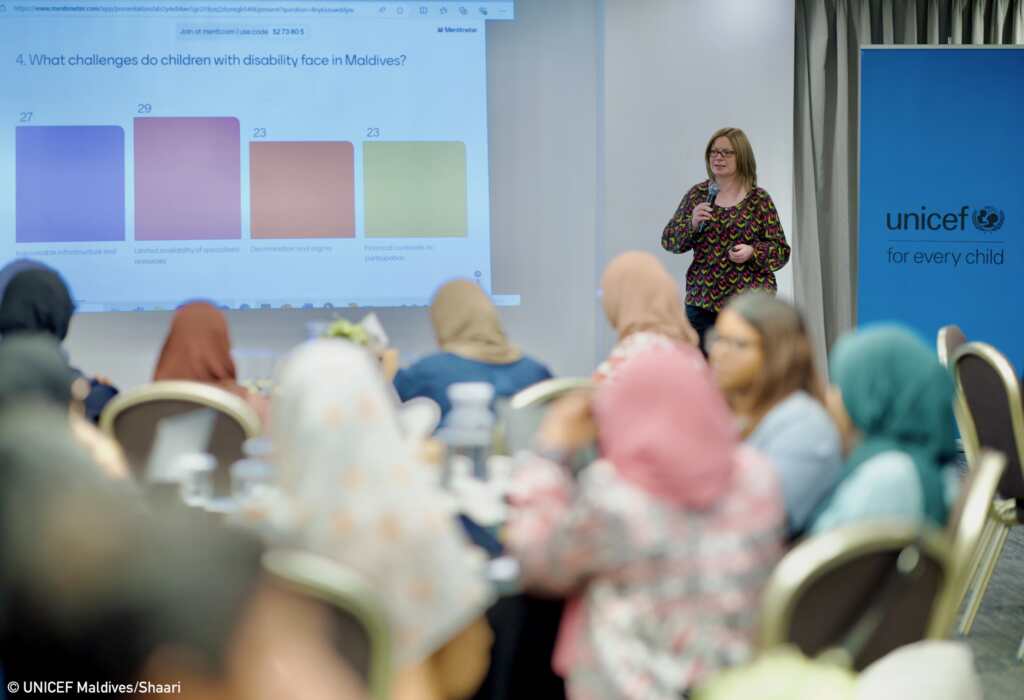
In the Maldives, the orientation became a catalyst for deeper dialogue. What began as a twoday in-person introduction to the package quickly opened new conversations on early identification, referral pathways, multi-sector collaboration, and even the possible development of a future UNICEF Country Programme disability inclusion strategy.
Ethiopia was the first country in Africa where IAG delivered the ToT sessions to staff in field offices using a fully online modality, supported by UNICEF HQ funding. Despite difficult circumstances and unreliable internet connections, staff showed dedication to participating and commitment to cascading the training to local partner organisations in their humanitarian response programme. The ToT has now also been delivered in Angola and plans to translate into French and utilise the package in Mali are underway, led by UNICEF staff initially supported by IAG through the HQ funded global rollout project. In Libya, the package has travelled further than expected. After contextualised ToT support, UNICEF Libya trained the Libyan Red Crescent, who then partnered with OPDs to deliver inclusive first aid training – a clear example of cascading impact. Participants also emphasised how the content aligned with their work, noting the materials were “excellent… and highly relevant.”
In Viet Nam, the package has been integrated into teacher training at two national universities, reaching trainee teachers who will carry inclusive practice into their future classrooms. Following the ToT, 100 per cent of participants said they planned to apply the content in their work.
In Iraq, early rollout prioritised social workers, many describing the sessions as the first structured opportunity to understand disability inclusion within their professional roles.
These examples across humanitarian and development contexts demonstrate a shared commitment to learning, adapting, and strengthening systems from within.
Lived experience at the heart of the work
Across almost every country involved in the rollout, people with lived experience of disability have shaped translation, contextualisation, agenda design, and facilitation. Their impact has been profound. Participants often describe hearing directly from people with disabilities, in videos or in person, as the most impactful part of the training. As one participant in the Maldives shared:
“It helped me to understand that each person experiences disability differently… we should not make assumptions.”
OPDs have provided detailed feedback on terminology, relevance of examples, accessibility of materials, and local adaptation needs. Their leadership has made the content meaningful, relatable, and grounded in real lived experience. This reinforces a central message: Meaningful participation is not optional – it is foundational.
What this tells us about forward-looking systems change
Several clear patterns are emerging that highlight the package’s long‑term potential to drive systemic change:
- Embedding in national systems: Multiple COs plan to integrate modules into pre‑service teacher education, induction training for social workers, and government-led capacity building.
- Advancing policy commitments: Country offices report increased OPD engagement, improved cross‑sector understanding, and stronger alignment with national and regional disability commitments.
- Opening pathways for structural reform: Conversations about early identification (Maldives), inclusive education (Viet Nam), and emergencies contextualisation (Venezuela) reflect how the training stimulates institutional change beyond workshop rooms.
- A global learning ecosystem is emerging: An online peer support network is enabling trained facilitators to exchange materials, ask questions, and learn from each other, providing a vital mechanism for long-term sustainability.
Looking forward, together
As IAG, we remain committed to supporting UNICEF at HQ and country levels as they continue this journey. Our role has been to accompany, guide, and equip, but it is country teams, key stakeholders, and OPDs who bring the content to life.
The package continues to grow through each adaptation, each discussion, each lived‑experience story, and each training. Its evolution belongs to all who use it.
The work ahead remains significant, but the momentum is real and the direction is clear. Together, UNICEF, OPDs, governments, civil society, and Frontline Workers are strengthening systems that see, value, and include every child, ensuring no-one is left behind.
https://cbm-global.org/news-iag/disability-inclusion-training-frontline-workers
Other IAG Projects
Strengthening disability inclusion with CAFOD
Reflections and learning from the partnership Over the last two years, we have partnered with CAFOD to strengthen disability inclusion...

Partnering for Change: Building Disability Leadership through Advisory Fellowships
Partnering for change At CBM Global’s Inclusion Advisory Group (IAG),...
Towards systems change: collaboration for disability-inclusive climate action
In December, to mark the International Day of Persons with...