
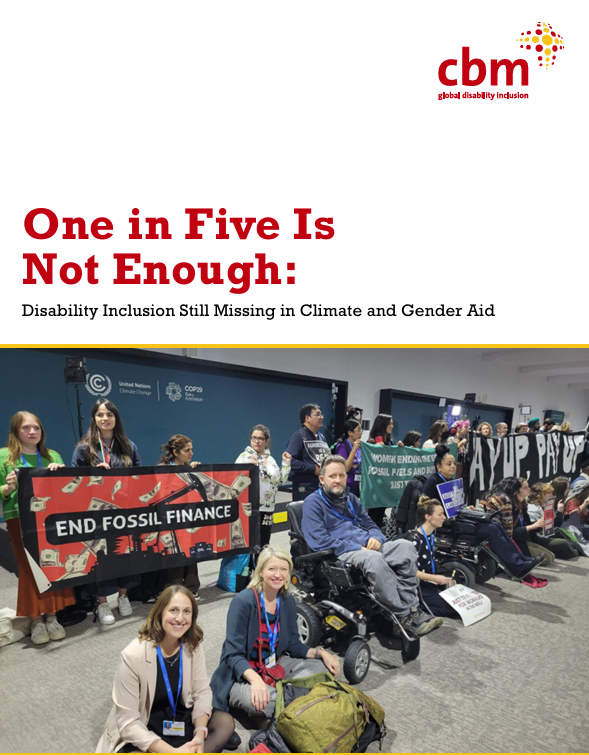
One in Five Is Not Enough: The gains on Disability Inclusion have not gone far enough
News | December 2, 2025
One in Five Is Not Enough: The gains on Disability Inclusion have not gone far enough. Efforts to mainstream disability in Climate, Disaster Risk Reduction and Gender must be accelerated.
A research report entitled “One in Five is not enough” was launched on December 2nd by CBM Global Disability inclusion. The report explored the overlapping and intersection of the OECD Disability DAC markers with the DAC marker for Climate, Disaster Risk Reduction and Gender Equality. The findings of the report suggests that efforts by donor governments to include disability in Official Development Assistance, – ODA for Climate, Disaster Risk Reduction and Gender Equality has been progressing up until 2023, but at far too slow a pace and could now be at risk of reversal due to decreases in ODA which is projected to between 9 to 17% drop in official development assistance in 2025 with further cuts in 2026.
Key Findings from the One in Five is not Enough report
The research explored five years of data (2019–2023) from the 33 members of the OECD-DAC. The research overall finding, pointed to a stark reality: that staying at the current pace it could take until 2058 for climate adaptation ODA to be fully disability-related, and 2068 for gender equality ODA. The real-life impact of this is persons with disabilities may result in lost lives, exclusion and precarity for women, girls and persons with disabilities, especially those living in low-and middle-income countries.
Top-line data from the report
The research brief breaks down the data across the different policy areas and you can read more in detail in the report. For the 2023 data, less than one in five of the DAC members’ Climate, DRR or Gender Equality-related ODA activities were reported to be disability-related. Across the three areas, the data showed:
- 16% of adaptation-related ODA activities were reported to be disability-related
- 19% of mitigation-related ODA activities were reported to be disability-related
- 17% of desertification-related ODA activities were reported to be disability-related
- 17% of DRR-related ODA activities were reported to be disability-related
- 17% of gender equality-related ODA activities were reported to be disability-related
Put another way, the research suggests that, for over 80% of ODA activities in the crucial areas of climate, DRR and gender, either persons with disabilities were not included, or there is no data. This is a serious gap and suggests that disability inclusion it is not a core component of climate, DRR and gender strategies.
Why is it important to have this type of data?
Persons with disabilities are impacted by climate disasters and we know that gender inequalities amplify existing barriers for persons with disabilities. Understanding how ODA is supporting measures to tackle these intersecting aspects is critical. We know that evacuation plans often exclude persons with disabilities; social protection systems fail to account for their needs; and women and girls with disabilities face compounded discrimination in education, health, and livelihoods. Some climate policies even risk harm, such as making essential products inaccessible or diverting funds away from disability priorities. Having this type of analysis helps identify the gaps in these critical policy areas with respect to disability inclusion and can support assessing if there is any coherence between the three policy areas and also where investment on disability inclusion is needed.
Coherence in policy and funding is the way forward
Increasing objectives that prioritise disability inclusion is a good way to start closing the policy and financial commitments gaps. ODA is decreasing but measures to effectively mainstream disability must be accelerated. Article 32 of the CRPD requires governments to ensure that all of its international cooperation efforts including ODA is accessible to and inclusive of persons with disabilities. This must be done in a systematic way ensuring disability inclusion moves beyond niche funding and pilot projects to being mainstreamed in climate, disaster risk reduction and gender equality for longer term sustainability. To support this, the research presents some recommendations below.
1. Make Disability Inclusion Non-Negotiable: When designing climate, DRR and gender related ODA, make sure disability inclusion is included as an objective. Some of the past responses to this request have included, “not all projects are relevant to disability inclusion or to persons with disabilities”. The examples highlighted in this research demonstrate how dangerous this assumption can be. Water and sanitation, food security for smallholder farmers, ending violence against women and girls, are all relevant to persons with disabilities. Programme and activity design under the OECD DAC policy markers must comply with CRPD Article 32. Disability inclusion should be embedded in every stage from design to implementation and monitoring.’
2. Adopt a Twin-Track Approach: Funding for ODA will continue to decline but efforts to ensure disability inclusion across critical development policy areas must not. A twin track approach maintaining focus on ensuring persons with disabilities and their representative organisations are supported, while also ensuring disability inclusion is mainstreamed across all programmes and scaled up is vital if we want to address systemic barriers and have transformative mainstreaming. Disability inclusion should be part of the overall spend, not just the niche.
3. Strengthen Accountability: In the changing landscape of donor commitments, accountability has become even more important. The disability marker data, has limitations, we know that, but there are some steps that can help.
- Firstly, use the OECD-DAC disability marker consistently across all ODA spending, this is achievable with focused advocacy.
- Secondly, review and tighten marker eligibility criteria to align with CRPD standards. Adopt minimum criteria similar to the Gender Equality Marker.
- Third and finally, improve data quality, accessibility and transparency to ensure reported inclusion reflects reality. \
4. Invest in Disability-Focused Action: The research shows that current levels are shockingly low, less than 1.2% of climate and gender ODA activities have disability as a principal objective. This has to increase, as governments continue to pledge finance for climate action, DRR and gender equality, they should set ambitious targets for disability-focused funding.
5. Engage Organisations of Persons with Disabilities (OPDs): Inclusion cannot be tokenistic. OPDs must be involved in planning, implementation, and evaluation to ensure programmes reflect lived realities of persons with disabilities. ODA needs to also flow to OPDs, the need for a purpose code to track how funds reach OPDs is long overdue.
The Bottom Line
The growing demand by communities and movements for climate justice, gender equality, and disaster resilience cannot be achieved without disability inclusion. Leaving persons with disabilities behind is not only a violation of rights, it undermines the effectiveness of global development efforts. The data is clear: one in five is not enough. It’s time for urgent, systemic change.
https://cbm-global.org/news/one-in-five-is-not-enough
Related News

Changing the narrative: How community support is strengthening suicide prevention in Nepal
Today, Sunita is a community volunteer in Lamjung District,...
CBM Global strengthens its commitment to climate and environmental action
Climate and environmental crises are increasing risks for communities...
Nepal Flood Emergency Response: Ensuring People with Disabilities Are Not Left Behind
On 26 August 2026, a glacial collapse in Tibet...