
CRPD at 20: Protecting persons with albinism from violence, fear and injustice
Blog | June 8, 2026
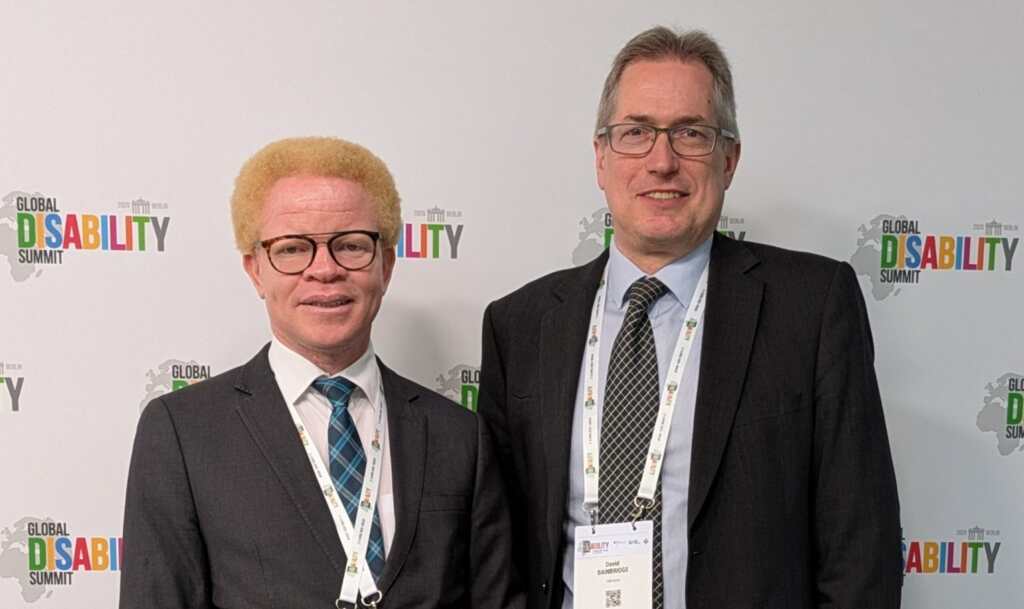
This blog is co-written by Bonface Massah, Executive Director of the Africa Albinism Network, and David Bainbridge, Executive Director of CBM Global Disability Inclusion, as part of our series marking 20 years of the Convention on the Rights of Persons with Disabilities.
2026 marks 20 years since the world agreed to protect the rights of persons with disabilities through the adoption of the Convention on the Rights of Persons with Disabilities (CRPD). The Conference of States Parties meets yearly in New York to discuss progress on CRPD implementation and this year’s theme is the CRPD at 20: celebrating and consolidating achievements and shaping the next phase of implementation in a changing world —and it is supported by several subthemes.
In writing this joint article as part of our series on the celebration of CRPD at 20, we would like to highlight one of the sub-themes: creating a world free from exploitation, violence and abuse for all persons with disabilities. In 2026, three horrific attacks have been recorded in Madagascar, all of them involving children with albinism. Attacks are persistent over the years, including six cases in 2022, eight in 2023, three in 2024, and one in 2025. Each attack is not just a number—it’s a person, a family, and a community living in fear. The threat remains real and unresolved.
Considering the recent killings of persons with albinism in Madagascar as well as in Malawi and the persistent threat to life that many from the albinism community face, we highlight the importance of stepping up efforts to protect the lives of persons with albinism (Article 10), ensuring the integrity of persons with albinism is respected and upheld (Article 17) and most importantly, that persons with albinism and their families have access to justice (Article 13). We also share reflections on leadership and collaboration and set out a call for action.
Equal Participation in Legal Proceedings
Article 17 protects the integrity of the person, yet harmful myths and false beliefs still target the bodies of persons with albinism. The recent cases in Madagascar and Malawi remind us that the problem is not only violence itself but also the fear, silence, and lack of protection that surround it. Families often live with trauma. Communities may be afraid to report. Survivors and witnesses may not feel safe. This situation is why access to justice must begin from the first moment a case is reported, not only when it reaches the courtroom.
Persons with albinism must be recognized as full rights-holders, capable of serving as direct and indirect participants in all legal processes. This includes their role as witnesses during investigations and preliminary stages. Ensuring their voices are heard is essential to dismantling barriers that have historically excluded them from justice systems.
Access to Justice through Training
Article 13 guarantees access to justice but many families still struggle to report cases, obtain protection, follow investigations, or see perpetrators brought before the courts. Governments have a duty to provide effective access to justice for people with albinism. This requires targeted training for judicial actors, including police, prison officials, immigration officers and investigators, to address discrimination, protect vulnerable witnesses, and uphold dignity. Like in Malawi and Zambia, such training fosters a system where persons with albinism can engage without fear or prejudice. Protection starts with understanding. Law enforcers need to know that albinism is a genetic condition, not a myth, and persons with albinism should be called by their names, not reduced to their condition. Properly recording cases as involving persons with albinism, protecting witnesses, making police stations accessible, and preventing attacks before they happen can make justice feel real for families.
Affirming the Right to Life and Integrity
Article 10 speaks about the right to life, but persons with albinism continue to face attacks, abductions, and killings in some countries. Government institutions, civil society organizations, and development partners reaffirm that every human being is entitled to life. For persons with albinism, this right must be safeguarded through proactive measures, such as the national action plans on persons with albinism, that guarantee equal enjoyment of life opportunities, ensuring that respect for physical and mental integrity is upheld on the same level as for all other citizens.
The role of leadership and the importance of collaboration
Central to any meaningful response must be the leadership, voice and lived experience of persons with albinism themselves. Organisations of persons with albinism play a critical role in documenting violations, supporting survivors and families, raising awareness, and advocating for systemic change. They are indispensable actors in both prevention and response efforts. Upholding the principle of “nothing about us without us” is essential to achieving effective and sustainable solutions.
International non-governmental organisations (INGOs) have an important, but fundamentally supportive, role to play. This includes resourcing and supporting organisations of persons with albinism as equal partners, promoting their leadership in advocacy at national, regional and global levels, and ensuring that their perspectives inform policy and programme design. INGOs can use their platforms to amplify voices, challenge harmful narratives, and bring greater international attention to the risks faced by persons with albinism, particularly in contexts where these issues remain under-recognised.
Progress is possible
In over eight countries in Africa the implementation of the national action plans has demonstrated an ecosystem that integrates the human rights violations of persons with albinism by adapting to real-time emerging human rights issues and strengthening relationships to build trust in the community and ensure a quick response by the governments.
We also call for strengthened collaboration between governments, organisations of persons with albinism, INGOs and other civil society actors to ensure that prevention, protection and response mechanisms are joined up and effective.
A world free from exploitation, violence and abuse will only be realised when persons with albinism are recognised, protected and empowered as equal citizens—and when their leadership is placed at the centre of all efforts to achieve this change.
A Call to Collective Action
The Africa Albinism Network calls upon all stakeholders to:
- Ensure equal access to justice and participation in judicial and investigative processes.
- Provide law enforcement and judicial training that eliminates bias and strengthens protection.
- Reaffirm the rights to life, dignity and integrity for persons with albinism.
- Accelerate implementation of National Action Plans and address issues highlighted in recent attack cases and reports.
- Promote collaboration among governments, civil society, and development partners to ensure equality and justice.
- Invest in awareness and prevention to combat stigma and harmful practices.
CBM Global supports and joins alongside AAN on this call to action and encourages others to also provide their support.
In case you missed the earlier pieces in our CRPD at 20 series, you can also read the blog by Mary Keogh, CBM Global’s Advocacy Director, and watch the video by José Viera, Executive Director of the International Disability Alliance. Both reflect on the continued importance of the CRPD and the work still needed to advance the rights of persons with disabilities.
https://cbm-global.org/blog/crpd-20-protecting-persons-with-albinism
Related News
Working with those most left behind means shifting power at every level
This article was written by David Bainbridge, Executive Director...
Reflections on the CRPD at 20: Laws Matter — But People Make Change
In this piece, Mary Keogh, CBM Global’s Advocacy Director,...
Reflecting on 2025: A Year of Shared Impact, Partnership, and Hope
Written by David Bainbridge, Executive Director of CBM Global...