


Our Achievements in 2025
In 2025, we began translating our new strategic priorities into action across programmes, advocacy and partnerships. Across our work, one theme stood out clearly: lasting inclusion depends on shifting power, strengthening local leadership and tackling the structural barriers that continue to exclude people with disabilities.
We took further steps to work with those most at risk, especially underrepresented groups who are often left behind or considered harder to reach.
One important example was the finalisation of our Mental Health and Psychosocial Disability Framework in 2025. Its first and foundational priority is to scale up our work in partnership with OPDs and amplify the voices of people with psychosocial disabilities. Although the Convention on the Rights of Persons with Disabilities recognises the right to full inclusion, people with psychosocial disabilities remain underrepresented across much of our work and within the disability movement more broadly.
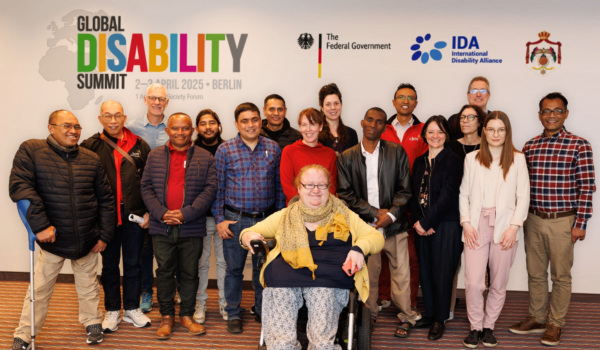
At the Global Disability Summit in Berlin, we made commitments to expand the number of programmes that work specifically with underrepresented groups, including women and girls with disabilities.
In 2025, we also launched Rights in Action, a new advocacy project funded by the Ministry of Foreign Affairs of Finland. The project addresses discrimination and human rights violations faced by people with disabilities, especially those from underrepresented groups, in Nigeria and Zimbabwe. Its design and implementation were co-created with 14 OPD partners, including the African Disability Forum, International Disability Alliance, Inclusion Africa, World Federation of the Deaf, the Federation of Organisations of Disabled Persons in Zimbabwe, Inclusive Friends Association, the Joint National Association of Persons with Disabilities in Nigeria, and the Zimbabwe National Association for Mental Health.
A Leap Fund was also established to provide small grants for grassroots action, local advocacy and organisational strengthening, primarily for OPD partners. In 2025, we provided 73 grants, many of them supporting work with underrepresented groups.
One example came from Nepal, where a grant from our Country Team supported the first Deafblind International Regional Conference in Asia, held in March. The event brought together 320 participants from 23 countries, including people with lived experience, disability advocates, policy makers and experts. It concluded with a resolution calling for policy reform, greater service accessibility and expanded employment opportunities for people with deafblindness.
Global Disability Summit 2025 commitments
We commit to:
- by 2027, ensuring that at least 20% of our funding to partners goes to OPD partners
- by 2027, increasing by 25% the number of projects with OPD organisational strengthening outcomes
- expanding the number of programmes that work specifically with the most left behind among underrepresented groups, including women and girls with disabilities
- advocating to institutional donors for flexible, longer-term funding to OPDs that includes core costs and supports organisational strengthening
Progress against these commitments will be monitored annually.
The preconditions for inclusion are the elements that need to be in place in society to create an enabling environment for inclusion and equity for people with disabilities. Without them, structural barriers continue to prevent people with disabilities from participating equally in programmes, services, opportunities and everyday life, even where disability inclusion practices are otherwise strong.
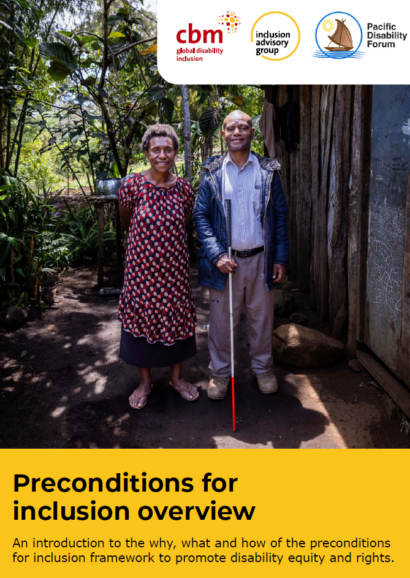
In 2025, we published a Preconditions for Inclusion overview brief, co-developed with the Pacific Disability Forum, to explain why this framework matters and how it can be applied.
We also prioritised programming, advocacy and advisory work that strengthens these preconditions at multiple levels.
In Vanuatu, for example, we supported the Vanuatu Disability Promotion & Advocacy Association through community-based inclusive development to work with 13 Area Council OPDs on accessibility audits and local advocacy in schools and churches. Building on this community evidence, and with support from the Pacific Disability Forum and CBM Global technical advice through the Growing Stronger Together initiative, the association prepared a successful submission that contributed to improved accessibility provisions in the National Building Code.
This OPD-led advocacy showed how community action can help strengthen the policy conditions needed for inclusion at scale.
CBM Global has long worked through partnerships, but we are also on an intentional journey to become more locally led and to shift decision-making power to partner organisations and local communities.
This reflects our belief that sustainable change requires partnerships rooted in equality, respect and shared leadership. For us, localisation is not a slogan. It is a practical shift that ensures those closest to the issues help lead the solutions.
In 2025, we developed an action plan to implement the localisation commitments finalised in 2024, and we continued to track progress.
A key step in this journey has been the use of routine partner feedback surveys. In 2025, we carried out a partner survey across all partner organisations and received an encouraging 84% response rate. Drawing on both the online survey and anonymous focus interview findings, we identified where progress has been made since the last survey three years ago and where more work is needed.

Partners highlighted openness, trust and agility as strengths in our relationships. They also noted progress in inclusive decision-making, with OPDs and local organisations increasingly taking leadership roles. At the same time, they identified areas for improvement, including greater autonomy in implementation, simpler reporting aligned with local systems, and more opportunities for capacity exchange and peer learning.
“CBM Global always focuses on partner capacity building. This is one of the reasons we feel they are a partner – we are trying to grow and CBM Global helps us do that.” Anonymous partner survey respondent
In 2025, we also strengthened the role of Country Advisory Panels in the countries where we work. These panels include members of the disability movement, OPDs, partner organisations and other relevant stakeholders. They help shape country strategies, review progress, advise on engagement with underrepresented groups, and act as critical friends to strengthen our work and maximise impact.
The climate crisis continues to deepen existing inequalities, with people with disabilities among those most affected. In 2025, CBM Global advanced both disability-inclusive climate advocacy and community-level resilience building.
At COP30, disability-focused international non-governmental organisations, OPD partners and allies from the climate movement came together to call for disability-inclusive climate justice. It marked a turning point for disability-inclusive climate advocacy and CBM Global was at the heart of it. We worked alongside OPDs and allies from Bangladesh, Indonesia, Kenya, Nepal, Nigeria, Zimbabwe, the Philippines, Ethiopia, Malawi, Rwanda, India, and Zambia, ensuring representation from diverse contexts.
We contributed to side events and shared new research on climate finance and disability inclusion. The findings underline the scale of the challenge: based on current trends, it could take until 2058 before all adaptation-related Official Development Assistance activities are disability-related, and fewer than 1 in 100 adaptation- and mitigation-related ODA activities currently have disability inclusion as a main objective. Positive progress was also made on establishing a disability caucus, with formal approval from the United Nations Framework Convention on Climate Change anticipated in 2026.
At community level, programmes strengthened resilience through livelihood diversification, financial inclusion and more resilient livelihood practices.
In southern Madagascar, for example, more than 1,600 households benefited from disability rights awareness, life skills training, cash transfers to address essential needs, referrals to rehabilitative services, psychosocial support, financial literacy training, small business skills development, seed funding and market linkages. Thirty inclusive Village Savings and Loans Associations were created, with savings shared at the end of the first 12-month cycle.
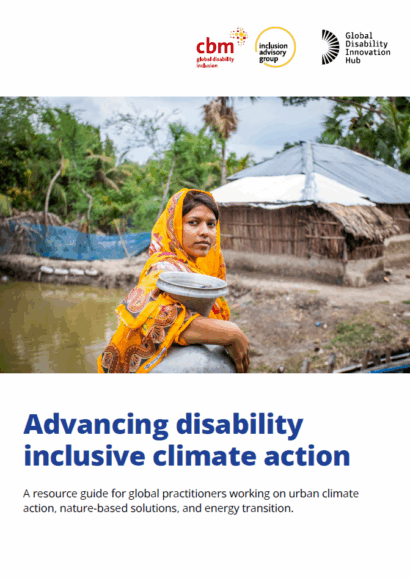
In 2025, CBM Global’s Inclusion Advisory Group also published Advancing disability inclusive climate action, a practical resource guide for global practitioners working on urban climate action, nature-based solutions and the energy transition, in partnership with the Global Disability Innovation Hub.